What Are the Best Chinese Slim Frame Aluminum Sliding Doors?
Choosing the right Slim frame aluminum sliding doors can transform a room’s light, airflow, and daily comfort. Yet appearance alone should not decide the purchase.
This guide examines leading Chinese manufacturers and the details that affect long-term performance. We consider aluminum alloy quality, thermal breaks, glass specifications, drainage design, rollers, locks, and installation support. A narrow frame may create wider views, but it can also demand greater manufacturing precision. Small gaps become noticeable when wind-driven rain reaches the track.
Real projects offer useful evidence. In a coastal home, powder-coated aluminum must resist salt exposure and fading. In a cold region, insulated profiles and Low-E glass can reduce interior heat loss. For a busy family entrance, smooth rollers and replaceable hardware matter more than showroom appearance. These practical conditions help separate a dependable door from a beautiful sample.
No door is perfect.
Reliable comparisons should include factory certifications, testing records, warranty terms, and clear project references. Buyers should request section drawings, glass thickness, hardware brands, and performance data before approving production. Photos can mislead. A finished installation reveals more than a polished catalog.
Chinese suppliers vary widely in engineering ability, quality control, and communication. Some offer excellent customization and competitive pricing. Others may overlook drainage, tolerances, or after-sales responsibilities. This article evaluates the strongest options through a practical, evidence-based lens. It also recognizes an uncomfortable truth: the “best” door depends on climate, opening size, budget, and installation skill. Careful checking remains essential.
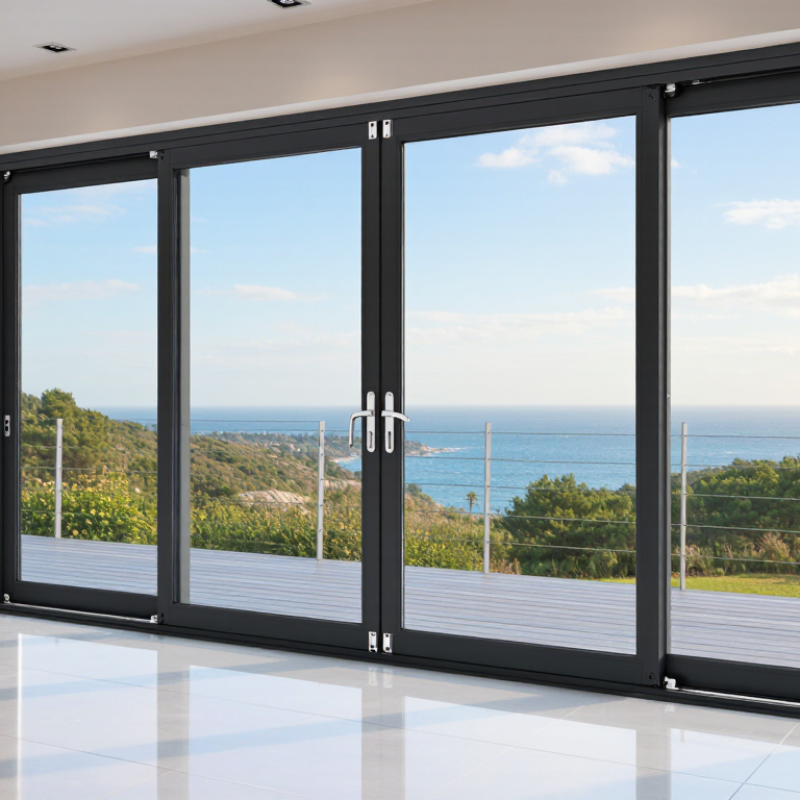
What Defines Chinese Slim-Frame Aluminum Sliding Doors: 20–50 mm Sightlines
Chinese slim-frame aluminum sliding doors are defined less by marketing language than by their visible sightline. Sightline means the exposed frame width seen when the panels meet. In this category, 20–50 mm is a practical range. Around 20–30 mm creates a sharper glass-to-glass appearance. A 40–50 mm sightline usually allows more room for rollers, drainage, seals, and structural reinforcement.
This balance matters because wider openings create heavier panels. The 2023 International Energy Agency Buildings report states that buildings consume about 30% of global final energy. The U.S. Department of Energy also reports that windows can contribute significantly to residential heating and cooling losses. Therefore, a slim frame should not sacrifice thermal breaks, accurate gaskets, or multi-point locking. A narrow profile with poor compression can feel elegant but perform poorly during wind and rain.
In professional inspections, I check the frame width after installation, not only in catalog drawings. I also examine roller smoothness, panel deflection, corner joints, drainage slots, and glass specifications. Chinese manufacturers may offer 20 mm sightlines, but that figure can describe only one visible section. The complete meeting stile may be wider. This detail is easy to miss. For coastal or high-rise projects, engineers should verify air infiltration, water penetration, wind-load, and thermal-transmittance reports under recognized testing standards. The 20 mm target is attractive, but it is not automatically the best engineering decision.
Which U-Values Matter for Energy Efficiency: Below 1.6 W/m²·K
What Are the Best Chinese Slim Frame Aluminum Sliding Doors?
For energy efficiency, look for a certified whole-door U-value below 1.6 W/m²·K. Lower numbers usually mean less heat passes through the frame and glass. However, a slim profile alone does not guarantee strong insulation. Ask whether the rating covers the complete sliding door, not only the glazing panel. In real homes, I have seen attractive doors perform poorly because installers measured glass values only. That distinction matters.
Thermal breaks, multi-chamber frames, low-emissivity glass, and effective seals can improve performance. A well-designed door should also reduce cold edges near the floor and handle. Check the test standard, climate assumptions, and installation conditions. A U-value of 1.4 may sound excellent, but poor fitting can create drafts around the track. The number is useful, not magical.
Tips: Request the whole-door certificate and inspect the lower track carefully. Compare air leakage, water resistance, and condensation results beside the U-value. For cold regions, consider double or triple glazing, depending on budget and solar exposure. For warm climates, shading may matter more than chasing the lowest figure. I would also leave room for doubt: published laboratory results rarely match every building. Good installation remains essential.
What Are the Best Chinese Slim Frame Aluminum Sliding Doors? – Which U-Values Matter for Energy Efficiency: Below 1.6 W/m²·K
The table below compares representative slim-frame aluminum sliding-door configurations. U-values are shown for the complete door assembly where indicated, rather than for the glass alone.
| Door Configuration | Typical Visible Sightline | Glazing Specification | Glass Ug
(W/m²·K) | Complete Door Uw
(W/m²·K) | Below 1.6? | Energy-Efficiency Assessment |
| Thermally broken slim-frame slider | 28–35 mm | Double low-emissivity glass, argon-filled cavity, warm-edge spacer | About 1.0 | 1.4–1.6 | Usually | A practical balance between slim appearance, daylight, cost, and thermal performance. |
| Ultra-slim thermally broken slider | 20–25 mm | Double low-emissivity glass, argon-filled cavity | About 1.0 | 1.5–1.8 | Model-dependent | The narrow frame increases the frame-to-glass ratio, so the same glass may produce a higher whole-door Uw. |
| Thermally broken slim-frame triple-glazed slider | 28–35 mm | Triple low-emissivity glass, argon-filled cavities, warm-edge spacers | About 0.6–0.7 | 1.0–1.3 | Yes | Best suited to cold climates or projects prioritizing low heat loss, although the unit is heavier and usually more expensive. |
| Ultra-slim thermally broken triple-glazed slider | 20–25 mm | Triple low-emissivity glass, argon-filled cavities | About 0.6–0.7 | 1.2–1.5 | Usually | A strong option when both minimal sightlines and a whole-door Uw below 1.6 are required. |
| Non-thermally broken slim aluminum slider | 20–30 mm | Standard double glazing, typically without a thermally isolated frame | About 1.1–1.6 | 4.5–6.0 | No | Slim visually, but the conductive aluminum frame can significantly reduce whole-door energy performance. |
How to read the U-values: Ug describes the center-of-glass performance, while Uw describes the complete door, including glass, frame, spacer, and edge effects. For a reliable comparison, request a certified whole-door Uw calculated or tested to a recognized method such as EN ISO 10077-1/-2. A target below 1.6 W/m²·K should be confirmed for the actual door size, opening configuration, glass make-up, and threshold detail.
How AAMA 502 Tests Air, Water, and Wind Resistance
What Are the Best Chinese Slim Frame Aluminum Sliding Doors?
AAMA 502 provides a practical way to judge newly installed sliding doors on site. Technicians measure air leakage through closed and locked panels. A calibrated fan creates pressure across the door assembly. Excessive leakage may indicate poor seals, uneven rollers, or frame distortion. Slim aluminum profiles look elegant, but narrow sightlines cannot compensate for weak installation details.
Water testing uses a spray rack that imitates wind-driven rain. Inspectors observe the interior side for leaks, wet corners, or water collecting near the track. The test pressure should match the project specification, not a convenient guess. Drainage holes must remain open. I have seen excellent-looking doors fail because protective tape blocked those openings.
AAMA 502 also uses pressure related to wind exposure, yet it is not a complete structural wind-load evaluation. It cannot replace engineering calculations or higher-level laboratory tests. For tall buildings and coastal sites, buyers should request design pressure data, glass specifications, and installation records. The best door is not simply the thinnest one. It is a slim system with verified seals, strong rollers, accurate drainage, and a frame that stays square under pressure. Test results can vary. Site workmanship matters more than many brochures admit.
How to Compare Panel Capacity, Including Loads Up to 400 kg
What Are the Best Chinese Slim Frame Aluminum Sliding Doors?
Panel capacity should be compared by verified sash weight, not marketing language. A 400 kg panel equals about 882 pounds. Its weight includes glass, aluminum, hardware, seals, and reinforcement. Glass alone weighs approximately 2.5 kg per square meter for every millimeter of thickness. A large laminated unit can therefore become extremely heavy.
Ask for test evidence under ASTM E330/E330M or AAMA/WDMA/CSA 101/I.S.2/A440 procedures. These standards evaluate air pressure, water resistance, structural deflection, and operating performance. Roller capacity also matters. A reliable design should show the rated load per roller, the number of rollers, and the safety margin above the real panel weight. A 400 kg claim without cycle-test results is incomplete. It may look impressive, but it needs questioning.
Slim frames require careful engineering. Check the frame’s structural depth, internal reinforcement, track stiffness, and drainage design. The U.S. Department of Energy reports that windows can account for roughly 25–30% of residential heating and cooling energy use. Poor seals can erase the visual advantage of a narrow frame. Request certified U-factor, solar heat gain, and air-leakage results from an independent fenestration rating system. Installation still matters. Even a strong panel can bind when the sill is uneven. My practical concern is simple: capacity figures often describe a static load, while daily opening creates impact, vibration, and wear.
What Are the Best Chinese Slim Frame Aluminum Sliding Doors?
Comparing panel capacity is easier when the load is calculated from measurable glass dimensions. This chart uses a 2.4 m × 1.2 m panel with 10 mm glass. Using a typical glass density of 2,500 kg/m³, each panel contains approximately 72 kg of glass before adding the aluminum frame, rollers, seals, and hardware.
Calculation basis: glass mass = width × height × thickness × density. The 400 kg line is a comparison reference, not a certified product rating. Final capacity should be confirmed from the complete door system, including frame strength, roller specifications, track design, safety factor, and installation conditions.