
nbc logo (2)
Office address
National Engineering Industries Ltd.
Khatipura Road Jaipur – 302006 Rajasthan, India
Phone Number

Toll Free: 1800 3000 6222
Telephone: +91 141 222 3221
Fax: +91 141 222 1926, 222 2259
CIN: U29130WB1946PLC013643

China Top Industrial Ball Bearings Suppliers?

China’s industrial ball bearings sector combines vast production capacity with uneven supplier quality. This guide examines manufacturers, specialist exporters, and factory-direct suppliers serving machinery, robotics, automotive, energy, and material-handling applications.

Fortune Business Insights valued the global ball bearing market at approximately USD 19.46 billion in 2023. It projects the market to reach USD 32.74 billion by 2032. Other reports publish different figures. Their definitions, regions, and product categories vary. That difference matters when comparing China supplier claims.

Performance begins with application details. Load, speed, temperature, lubrication, sealing, noise, and contamination should guide selection. A polished catalog is not enough. Request ISO 9001 certification, material certificates, inspection records, and batch traceability. For automotive programs, IATF 16949 may be essential. ISO 281 calculations can support rated-life comparisons, but they do not replace field testing.

Bearing engineer Tedric A. Harris emphasized, “A bearing must be selected for the application, not simply for its size.” The principle remains practical. A small dimensional error can create vibration, heat, and premature failure. Ask suppliers about steel grade, heat treatment, raceway finish, internal clearance, grease, and vibration testing. Examine samples before approving volume orders.

China offers competitive pricing and deep manufacturing experience. Yet the cheapest quotation may hide thinner seals, inconsistent hardness, or weak documentation. This guide therefore weighs engineering evidence, auditability, export experience, and after-sales support. It also acknowledges an uncomfortable point: supplier rankings can change quickly. Production lines, ownership, and subcontracting arrangements deserve fresh verification before every major purchase.
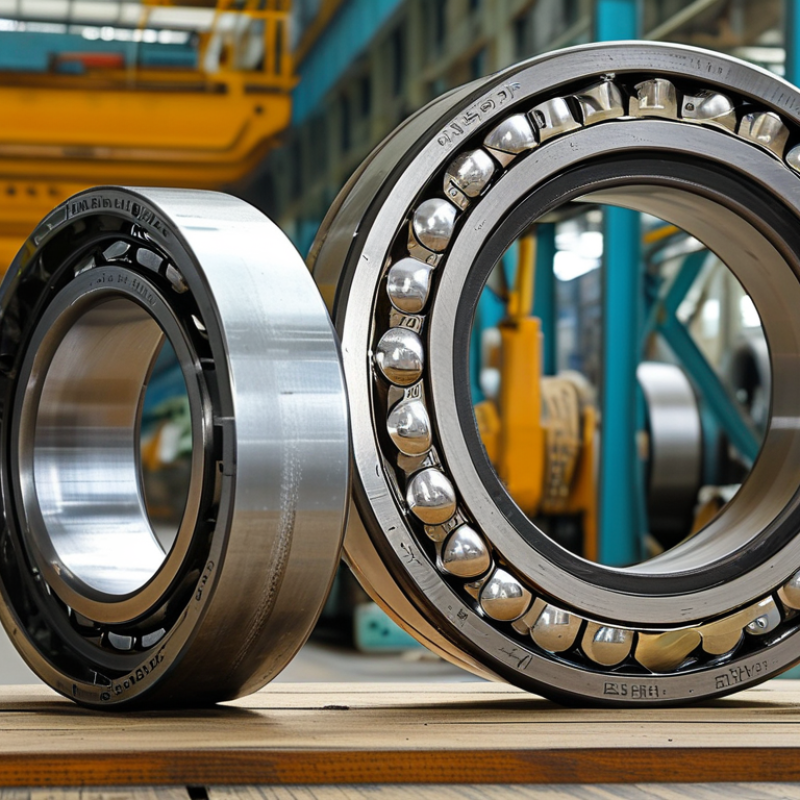
China Top Industrial Ball Bearings Suppliers?

China’s Industrial Ball Bearing Supplier Landscape

China’s industrial ball bearing supplier landscape is broad, regional, and increasingly specialized. Zhejiang remains a major production hub, especially for small and medium bearings. Jiangsu, Shandong, and Liaoning also support heavy-duty and industrial applications. These clusters offer dense machining networks, heat-treatment services, and nearby testing facilities.

Market data explains the competition. Fortune Business Insights estimates the global ball bearing market at about USD 18.9 billion in 2022, with continued growth through 2030. UN Comtrade trade data for HS 8482 also places China among the leading global exporters of bearing products. However, export volume does not prove consistent quality. Buyers should examine application records, dimensional inspection methods, steel traceability, and failure-rate data.

The practical difference appears on the factory floor. A reliable supplier can provide material certificates, vibration readings, clearance measurements, and batch-level records. Ask for sample testing before approving regular production. Shortlist suppliers by operating speed, load rating, sealing design, and service capability, not only unit price. This part is often underestimated. A lower quotation may hide weaker grease control or unstable heat treatment. Industry reports provide useful direction, but direct audits still matter. Some supplier information remains difficult to verify, especially when websites present outdated equipment or incomplete certifications.

Types of Industrial Ball Bearings Made in China

Types of Industrial Ball Bearings Made in China

China manufactures several industrial bearing types for machinery, conveyors, pumps, motors, and factory automation. Deep-groove ball bearings handle radial loads and moderate axial loads. They are common in electric motors and conveyor rollers. Angular-contact bearings support combined loads at higher speeds. Machine-tool spindles often use matched pairs for better accuracy. Small details matter here.

Tapered roller bearings suit heavy radial and axial forces, especially in gearboxes and vehicle equipment. Spherical roller bearings tolerate shaft misalignment and vibration. Cylindrical roller bearings provide high radial capacity where stiffness is important. Thrust ball bearings manage axial loads, but they are not ideal for heavy radial pressure. Chinese factories may also produce sealed, shielded, stainless-steel, and high-temperature versions. Material selection, heat treatment, grinding accuracy, and final inspection strongly affect service life. In practice, impressive catalog figures can still disappoint when lubrication or alignment is ignored.

Tips: Confirm the load direction, speed, temperature, and housing size before ordering. Ask for dimensional reports, hardness data, and noise-test records. Choose the correct clearance, seal type, and grease for the operating environment. A low price is not a complete quality assessment. Test a small batch under real working conditions before larger purchases. That step takes time, but it can reveal fit or vibration problems early.

Key Manufacturing Standards and Quality Indicators

China Top Industrial Ball Bearings Suppliers?

When evaluating industrial ball bearing suppliers in China, manufacturing standards matter more than polished catalogs. Ask whether the factory follows ISO 9001 quality controls and applies recognized bearing standards, such as ISO 492 for dimensional accuracy and ISO 199 for load ratings. Check the actual inspection records, not only certificates. Experienced buyers should review steel cleanliness, heat-treatment hardness, raceway roughness, and seal performance. A bearing may look perfect while failing under heat or vibration.

Reliable suppliers measure bore diameter, radial clearance, roundness, and rotation noise with calibrated equipment. Request sampling data and process capability results, including Cpk values for critical dimensions. Traceability is equally important. Each production lot should connect to material records, inspection reports, and packing dates. In practical audits, I also examine the workshop floor. Clean storage, covered components, and controlled lubrication usually reveal more than a sales presentation. No factory is flawless. However, repeated missing records deserve serious attention.

Tips: Test samples under the real load, speed, temperature, and lubrication conditions. Compare vibration readings after running time, not immediately. Ask for a corrective-action report when defects appear. A supplier that explains limits openly may be more dependable than one promising zero problems. Check packaging too; damaged seals or oily cartons can indicate careless handling. Reserve final approval for verified performance.

China Top Industrial Ball Bearings Suppliers? - Key Manufacturing Standards and Quality Indicators

Evaluation Dimension Relevant Standard or Reference Key Manufacturing or Quality Indicator Typical Industrial Requirement or Fact Recommended Verification Method
Dimensional accuracy ISO 492; GB/T 307.1 Bore diameter, outside diameter, width, and tolerance class Common classes include P0, P6, P5, P4, and P2; tighter classes provide improved running accuracy. Certified dimensional inspection using calibrated air gauges, micrometers, and form-measuring equipment
Radial internal clearance ISO 5753-1; GB/T 4604.1 Clearance group and consistency between production lots Normal clearance is commonly designated CN or C0; C2 is smaller and C3, C4, and C5 are progressively larger. Radial clearance measurement at controlled temperature with documented sampling plans
Bearing steel quality ISO 683-17; GB/T 18254 Material grade, cleanliness, carbide distribution, inclusions, and heat-treatment response High-carbon chromium bearing steel such as 100Cr6 or its national equivalents is widely used for rolling elements and rings. Mill certificates, chemical analysis, metallographic examination, ultrasonic testing, and inclusion-rating reports
Heat treatment ISO 683-17; supplier process specifications Hardness, retained austenite, dimensional stability, and core-to-surface consistency Bearing rings made from high-carbon chromium steel are commonly hardened to approximately 58–64 HRC, subject to the approved grade and process. Hardness mapping, metallographic inspection, and retained-austenite testing on qualified samples
Raceway and ball surface finish ISO 4287; ISO 4288 Surface roughness, waviness, grinding burns, dents, and scratches Lower and more consistent roughness generally supports reduced friction, noise, and lubricant degradation; the exact limit depends on bearing size and application. Profilometer measurements, visual inspection, burn detection, and roundness or waviness analysis
Geometric accuracy ISO 492; ISO 199 Roundness, runout, parallelism, axial variation, and assembled rotational accuracy Higher precision classes require tighter limits for rotational and dimensional deviations than standard P0 products. Roundness tester, runout tester, coordinate measuring machine, and final assembled inspection
Load rating and service life ISO 281; ISO 76 Dynamic load rating, static load rating, calculated rating life, and safety factor Basic rating life is calculated from load, speed, and bearing type; actual life also depends on lubrication, contamination, alignment, and installation. Verify load ratings from technical drawings and recalculate life using the operating duty cycle
Noise and vibration ISO 15242 Vibration velocity or acceleration, noise level, and frequency spectrum Low-noise applications require controlled cleanliness, accurate geometry, consistent preload or clearance, and clearly defined acceptance limits. Vibration testing on calibrated equipment under specified speed, load, lubrication, and mounting conditions
Cage and retainer performance Product drawing and application specification Cage material, pocket accuracy, rivet or snap integrity, and resistance to lubricant and temperature Steel cages are common; polymer cages may reduce noise and mass but require compatibility checks for temperature, speed, and lubricant. Material certification, dimensional inspection, cage balance testing, and application-specific endurance tests
Lubrication and sealing ISO 6743-9; manufacturer technical specification Grease type, fill quantity, seal or shield design, torque, and operating temperature range Common designations include open, shielded, and sealed configurations; grease compatibility and relubrication requirements must be confirmed. Grease certificate review, fill-weight inspection, leakage testing, and temperature-rise testing
Cleanliness and contamination control ISO 16232 principles; internal cleanliness specification Particle count, particle size, residual machining debris, and assembly-environment control Clean assembly, filtered washing, controlled packaging, and traceable handling reduce premature fatigue and vibration problems. Extract-and-weigh or microscopic cleanliness analysis, process audits, and sealed-package inspections
Production traceability ISO 9001 quality-management principles Lot number, material heat number, process records, inspection results, and nonconformance history Each shipment should be traceable from raw material and heat treatment through grinding, assembly, inspection, and packaging. Review batch records, certificates of conformity, inspection reports, and corrective-action documentation
Supplier qualification ISO 9001; application-specific audit criteria Process capability, calibration system, laboratory competence, delivery consistency, and corrective-action response A qualified supplier should demonstrate stable capability for critical characteristics rather than relying only on final-product inspection. Factory audit, capability studies, first-article approval, sample testing, and periodic performance review

Note: Acceptance limits should be defined in the approved drawing, purchase specification, and application duty cycle. Standard designations and equivalent national standards should be confirmed for the specific bearing type and revision.

How to Evaluate Chinese Bearing Suppliers

China Top Industrial Ball Bearings Suppliers?

How to Evaluate Chinese Bearing Suppliers

Choosing an industrial ball bearing supplier requires more than comparing unit prices. A polished website proves little. Request the factory address, production scope, quality certificates, and recent inspection records. Reliable suppliers should explain steel grades, heat treatment, clearance classes, sealing options, and expected service life. Their answers should be specific, not copied from a catalog.

Ask for samples before placing a large order. Measure bore diameter, outside diameter, noise, rotation smoothness, and radial play. Review material certificates and batch traceability documents. A professional supplier can provide inspection data for each shipment. Independent testing may also confirm hardness, vibration levels, and dimensional accuracy. Clarify packaging details, storage conditions, lead times, and replacement procedures in writing. Small details matter.

Tips: Compare at least three suppliers. Visit the factory when practical. Check whether production equipment appears maintained and organized. Ask how rejected parts are handled. Confirm communication speed during a technical discussion. Do not rely on the lowest quotation alone. I once treated fast replies as proof of reliability, but that judgment was incomplete. Slow answers can be serious, yet confident promises without evidence are worse. Evaluate performance over several conversations, sample checks, and trial orders.

How to Evaluate Chinese Industrial Bearing Suppliers

The chart presents a practical buyer-defined screening priority model. Quality consistency and technical compliance receive the highest weight because industrial bearings should be evaluated against requirements such as ISO 9001 quality management, ISO 281 load-life calculations, and ISO 492 dimensional accuracy. The percentages are evaluation weights, not company or market ratings.

Leading Industrial Applications and Supply Considerations

Industrial ball bearings support electric motors, pumps, gearboxes, conveyors, and machine tools.

Their operating conditions differ sharply. A dusty quarry needs seals and contamination control. A high-speed spindle needs low friction and precise balance.

The U.S. Department of Energy reports that motor-driven systems consume about 23% of U.S. electricity. Small efficiency losses can therefore become significant operating costs.

Supplier evaluation should begin with application data, not catalog size.

Check load direction, speed, temperature, lubrication, shaft fit, and expected service hours. ISO 281:2007 calculates basic rating life from dynamic load ratings and equivalent loads. Yet the calculation is not the whole story. Poor alignment, water ingress, and excessive preload can shorten actual life.

I have seen a correctly sized bearing fail early because storage conditions were ignored. Dry shelves matter.

Supply continuity also deserves attention.

Ask for material certificates, dimensional inspection records, batch traceability, and failure-analysis support. Confirm whether production follows recognized quality systems and whether testing covers noise, vibration, and hardness.

Keep critical sizes locally or regionally when downtime is costly. A cheaper unit price may hide longer lead times, inconsistent grease, or difficult returns. That is not always obvious.

Periodic sampling remains sensible, even with an approved supplier. Procurement teams should review total cost, including energy, replacement labor, lubrication, and unplanned stoppage.

Industry forecasts often cite steady bearing-market growth, but broad forecasts cannot replace site-specific evidence.

Practical trials are still necessary.